
The short answer
Cloudy headlights can often be restored when the visible problem is eligible deterioration on the exterior lens and the rest of the assembly is intact and operating normally. Repair or replacement is usually the better path when the cloudiness is inside the assembly, the lens or housing is cracked or deformed, mounting points are broken, internal optics are damaged, lighting components do not operate normally, or the exterior condition is too compromised for a consistent correction.
The word “cloudy” does not identify which path fits. Begin with the location and type of condition, then consider earlier work, remaining defects, lamp operation, and the cost and scope of each option. A clean-looking photograph or a quick surface change is not enough to make the decision.
Use the whole assembly, not the cloudy label
A headlamp is more than its outer plastic lens. The housing, vents, mounts, seals, reflector or projector, light source, wiring, connectors, modules, and aim all contribute to the complete system. Exterior restoration treats the exposed lens surface; it does not repair the other parts.
Use five questions to separate the options:
- Where is the condition? Yellowing, dullness, a chalky texture, and weathering on the exposed face may be exterior. Mist, droplets, streaks, pooled water, or staining visibly behind that face point inside.
- Is the assembly intact? Look for cracks, gaps, broken mounts, loose parts, impact marks, heat deformation, and damage around the rear housing.
- Does the lamp operate normally? A failed, flickering, dim, intermittent, or incorrectly aimed lamp needs diagnosis beyond appearance.
- What happened to the exterior before now? Prior sanding, polishing, coating, chemicals, or repeated touch-ups can leave an uneven surface and change what another correction can achieve.
- Which defects are acceptable if they remain? Road pitting, deeper scratches, coating edges, internal marks, and other damage may stay visible even when exterior haze improves.
If the location is uncertain, use the inside-or-outside guide before applying an abrasive or chemical product. Changing the surface first can hide useful evidence or add a second problem.
When restoration is usually the better fit
Exterior restoration is usually worth assessing when:
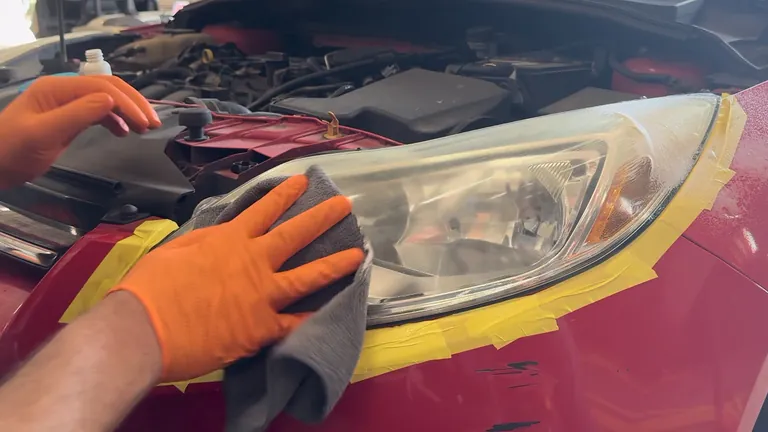
- the yellowing, haze, dullness, or rough texture is clearly on the outside;
- the lens, housing, mounting points, and rear covers are intact;
- there is no persistent water, internal staining, or loose internal component;
- the lamp operates normally and no separate electrical or aim concern is present;
- the exterior condition can be corrected evenly without chasing deep cracks, extensive crazing, or deformation; and
- the owner understands which deeper marks or earlier damage may remain visible.
Restoration preserves the installed assembly and targets the weathered outer surface instead of replacing an otherwise serviceable lamp. AAA’s limited headlamp-lens evaluation found that both the DIY and professional restoration methods it tested improved measured headlamp performance. AAA also states that the study was not a comprehensive comparison of every vehicle, product, or provider, so its results should not be treated as a universal outcome.
An eligible lens still needs realistic expectations. Restoration can address exterior deterioration, but it cannot erase every pit, deep scratch, internal mark, coating boundary, chemical fracture, or effect of previous work.
When repair or replacement is usually the better fit
Repair or replacement moves ahead of exterior restoration when the underlying problem belongs to the assembly rather than an eligible outer surface.
Structural damage
A cracked lens or housing, broken or missing mounting point, loose component, impact damage, gap, or deformed part needs vehicle-specific repair or replacement. GM’s current exterior-lamp damage guidance documents rear-housing fractures, broken mounting tabs, internal cracking, heat deformation, and chemical damage that can extend beyond ordinary weathering.
Internal moisture or staining
Exterior polishing cannot reach water, residue, or staining inside the lamp. Some vented assemblies can develop a temporary fine mist. Ford’s current headlamp guidance distinguishes that pattern from streaks, drip marks, large droplets, or a puddle inside the lamp and directs owners to have the vehicle checked when those larger patterns appear. Other vehicles may use different limits, so follow the information for the specific model.
Optical or electrical faults
A damaged reflector or projector, failed light source, corroded connector, wiring fault, module problem, or incorrect aim requires diagnosis of that system. Clearing the outside may change its appearance without correcting the operating fault.
Exterior damage beyond a practical correction
Extensive crazing, deep fracture-like lines, severe chemical damage, deformation, or a surface made uneven by repeated prior correction may make replacement the clearer decision. The threshold is not a universal age, color, or number of earlier attempts; it depends on the actual condition and what can be corrected consistently.
Condition-by-condition decision table
| What you observe | What it suggests | More appropriate next step |
|---|---|---|
| Even yellowing, dullness, or weathering on an intact outer lens | Eligible exterior deterioration may be present | Assess exterior restoration and the defects likely to remain |
| Exterior pitting, shallow scratches, or uneven coating wear | Restoration may improve clarity, but some texture may remain | Compare the expected improvement with the cost of replacement |
| Deep crazing, fracture-like chemical damage, or heat deformation | The lens may be damaged beyond ordinary weathering | Have the assembly assessed for repair or replacement |
| Crack, broken mount, damaged housing, gap, or loose component | Structural integrity is affected | Diagnose and repair or replace the damaged assembly |
| Fine temporary mist inside a vented lamp | May be model-permitted condensation | Check the vehicle-specific owner information and monitor the stated conditions |
| Large droplets, streaks, pooled water, or persistent internal staining | Water entry or another internal condition needs attention | Diagnose the assembly; exterior restoration is not the fix |
| Damaged reflector, projector, or another internal optical part | The light-control system is affected | Use vehicle-specific repair or replacement guidance |
| Lamp is failed, flickering, intermittent, unusually dim, or mis-aimed | An operating or aim concern exists, with or without lens haze | Diagnose the electrical, optical, and mounting condition separately |
More than one row can apply to the same lamp. For example, an oxidized exterior can exist with a cracked rear housing, temporary condensation, or an electrical fault. Treat each condition separately instead of assuming one service will solve all of them.
What previous restoration changes
Previous work does not automatically rule out another exterior restoration, but it makes the assessment more important. Look for:
- sanding scratches or a wavy surface that remains visible when the lens is dry;
- sharp coating edges, peeling, blotchy gloss, or an uneven boundary;
- a surface that becomes clear when wet and quickly looks dull again;
- residue at lens edges, on trim, or around seals;
- isolated burn marks, deep scuffs, chemical drip paths, or fracture-like lines; and
- a large difference between the two lamps that cannot be explained by ordinary dirt.
Do not keep repeating a correction just because the lens became cloudy again. First identify whether the returning appearance is new exterior weathering, a failing finish, damage left from the earlier work, an internal condition, or a combination. Another exterior service should be chosen for the condition that exists now, not for the label on the previous service.
Questions to ask before spending
Before buying a kit, authorizing professional restoration, or ordering an assembly, ask:
- What exact condition is the option meant to fix? The answer should identify exterior, internal, structural, optical, or electrical work rather than using “cloudy” as the diagnosis.
- What will remain visible or unchanged? Pitting, deep scratches, internal staining, damaged optics, and earlier work should be discussed before appearance expectations are set.
- What is included in the total path? For restoration, consider assessment, correction, refinement, protection, and aftercare. For repair or replacement, consider the correct assembly or component, installation, electrical connections, aim, and any vehicle-specific follow-up.
- Is the comparison for one lamp or the pair? One damaged assembly may need repair or replacement while the other only has exterior weathering. Appearance, age, and part history can differ from side to side.
- Is the lowest initial price solving the right problem? A less expensive exterior treatment has poor value when the condition is internal or structural; replacing an intact, restorable assembly may add cost without addressing why the lens weathered.
- Who is making the eligibility decision? A DIY choice places diagnosis and execution with the owner. A professional service should explain why the lens fits the service and which conditions fall outside it.
The DIY-versus-professional guide covers that second decision after restoration has been identified as a reasonable path.
Choose the next step
Choose an exterior-restoration assessment when the condition is on the outer lens, the complete assembly is intact and working, and the visible limits are acceptable. Review the Get Clear Lights service scope for eligible exterior restoration, current pricing, and the conditions that require another path.
Choose vehicle-specific diagnosis when the condition is internal, structural, optical, electrical, or mixed. That diagnosis may lead to a targeted repair, a replacement assembly, or correction of a separate operating concern.
When the evidence is incomplete, document the lens dry and in daylight, note what is outside and what is visibly inside, confirm whether moisture clears, record any cracks or loose parts, and describe how the lamp operates. A condition-based assessment is more useful than deciding from age, color, or a single photograph alone.
Sources
- Headlamp Lens DeteriorationAAA research report · Accessed
- Headlamp, Tail Lamp, License Lamp, or Fog/Driving Lamp Damage — Bulletin 02-08-42-001JGeneral Motors service bulletin hosted by NHTSA · Accessed
- Headlamps — Frequently Asked Questions2026 Ford Owner's Manual · Accessed